Following my Namibian road trip, it was time for me to return to Europe at the end of a long winter travel season.
Having found a seemingly fortuitous deal, I booked a one-way ticket on EgyptAir from Johannesburg to Madrid, via Cairo.
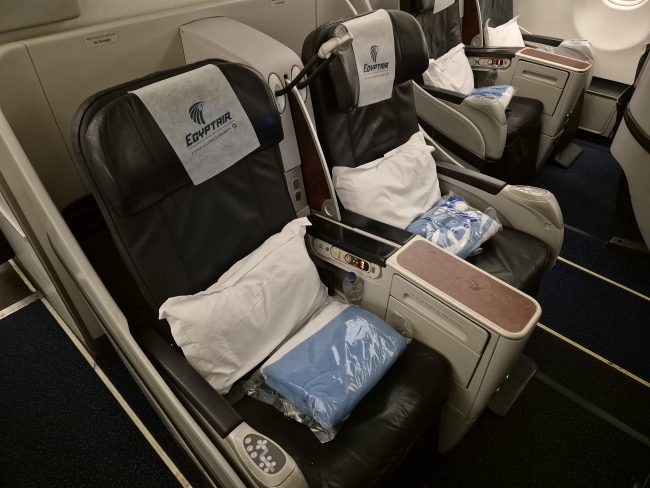
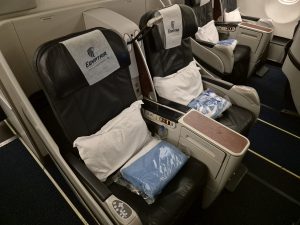
Originally, the eight-and-a-half hour, overnight flight from Johannesburg to Cairo was slated to be operated by EgyptAir’s 787-9 with fully flat seats in an all-aisle 1-2-1 configuration.
However, after the airline had advertised this product for several weeks, this was switched for the remainder of the season to an A330-300 with a significantly inferior 2-2-2, angle-flat configuration.
This was the first in a series of annoyances on this journey and would have been a deal breaker, had I known the configuration before booking. However, I was now stuck with the ticket, despite the bait-and-switch, so my only viable option was to try the product.
LOUNGE
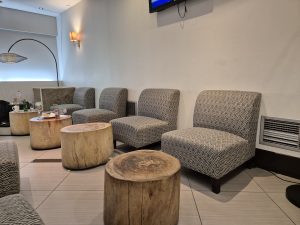
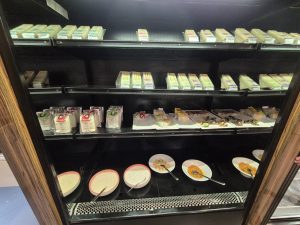
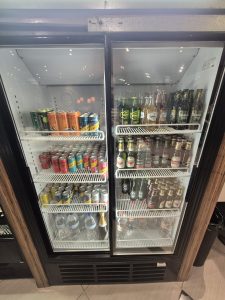
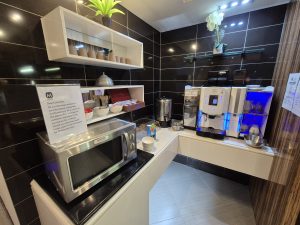
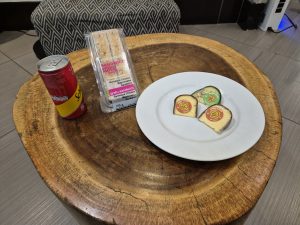
My evening started in the comfortable and simply catered SAA Baobab Lounge, which proved to be by far the best part of the flight experience.

JOHANNESBURG – CAIRO
Boarding was somewhat chaotic, with priority for Business Class passengers only loosely enforced.
It was soon confirmed that the configuration was indeed the dreaded angle-flat seats.
Once on board, I received a welcome drink of “orange juice”, which in reality was diluted cordial.
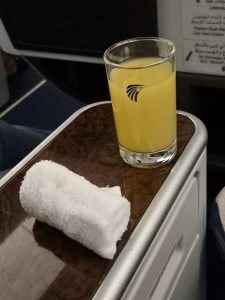
It is important to note that EgyptAir is a “dry” airline, meaning alcohol is not served or permitted to be consumed on board.
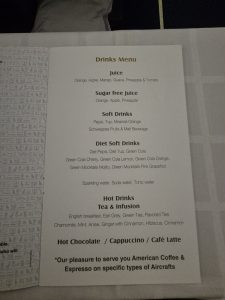
CATERING
Dinner was served around an hour and a half into the overnight flight and service was delivered at a lethargic pace, which was frustrating as I was keen to try to sleep.
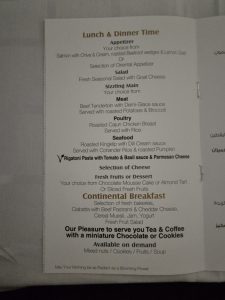
The appetisers were plentiful and reasonably tasty, although the salad leaves had seen better days.
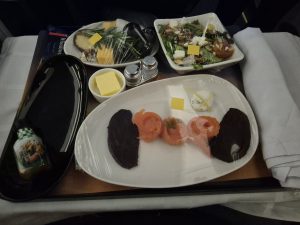
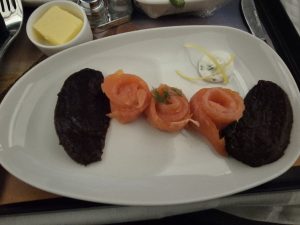

I chose the beef main, although I am often wary of beef on flights, as it tends to be disastrously overcooked. This was no exception.
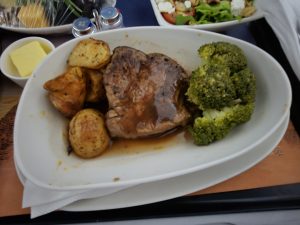
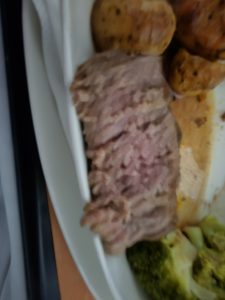
Drinks service was non-existent, so I drank the water that I had purchased at Johannesburg Airport.
When the cheese course was served, I walked up to the galley. Several minutes later, I was able to procure a grudgingly offered can of 7-up.
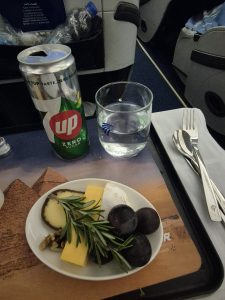
Dessert was a simple fruit platter, which was fresh and by far the best part of the meal.
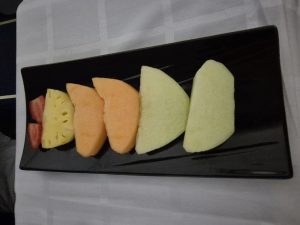
At the end of the meal, my tray went uncollected for around 45 minutes, until I eventually returned it to the galley myself.
BEDTIME
Around three hours into the flight, I reclined my seat as far as it would go and attempted to settle down to sleep.
The provided pillow and blanket were reasonably comfortable, but the angle of the seat and the ridges at hip and shoulder height made sleep impossible.
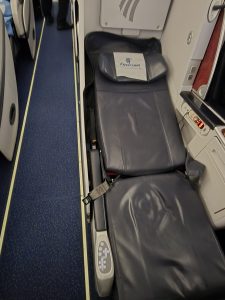
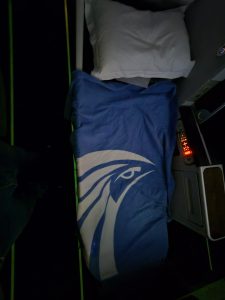
Unable to sleep, I got up a couple of times during the night and stretched my legs with a wander around the economy class cabin. The very low load factor on this flight meant that nearly every passenger had a flat row of three seats. Had I been able to find a vacant one, I would actually have “downgraded” myself and chosen to complete the flight in economy.
On my return from one of these little excursions, I found my seat stuck in a position around one-third reclined.
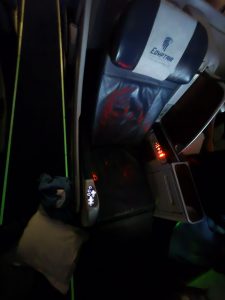
The crew initially forbade me to use any of the several vacant seats in the cabin and made around five minutes of languid attempts to fix my seat, before losing interest and retiring back to the galley. I simply ignored their instructions and moved myself to a vacant seat.
BREAKFAST
After a fully sleepless night, breakfast was served around an hour and a half before landing in Cairo.
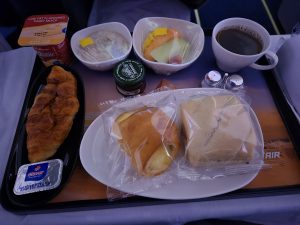
The continental breakfast with a beef ciabatta, croissant, fruit, yoghurt and black coffee was actually not bad and probably counted as the high point of the flight.
TRANSIT
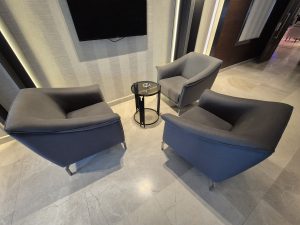
Arrival in Cairo produced the same chaos as I had previously experienced, with considerable harassment from officials at transit security before reaching the EgyptAir lounge.
Having dealt with the petty officialdom with the time honoured Egyptian tradition of a US $20 bill, I headed to the EgyptAir lounge, which conveniently had a smoking area, and settled down for a much needed nicotine fix.
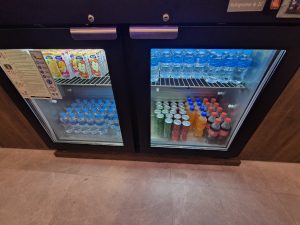
The lounge also offers a range of drinks, snacks and “hot” food, which was in fact stone cold.
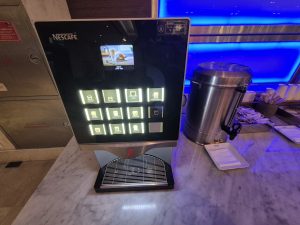
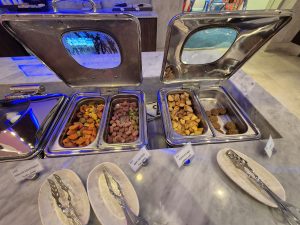
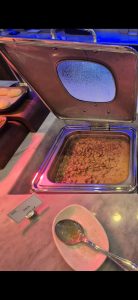
Deciding that discretion was the greater part of valour, I stuck to the coffee.
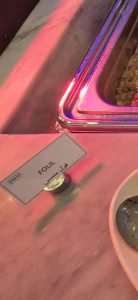
I agree.
CAIRO – MADRID
The onward sector to Madrid was operated by an Airbus A321. The business class cabin is equipped with reclining seats in a 2-2 configuration, which is considerably more spacious than the pretend business class offered by European carriers on narrow-body aircraft.
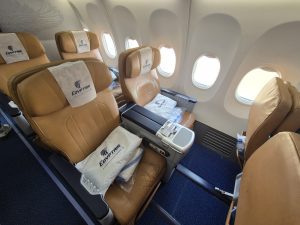
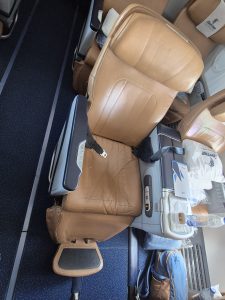
Had this been a stand-alone five-hour flight, I would have been more than happy with the hard product – it was certainly no worse that the seating on the A330. It is not, however, the way I would choose to spend that length of time after a sleepless overnight flight.
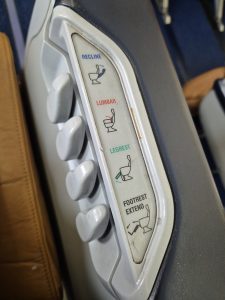
The cabin was somewhat dated, but everything was functional and the seat controls were very intuitive.
CATERING
Around an hour into the flight, a lunch service was begun. Initially, things looked rather promising, with an appetiser and salad served on a single tray before the main course.
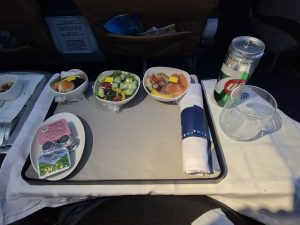
There were several options for the main course.
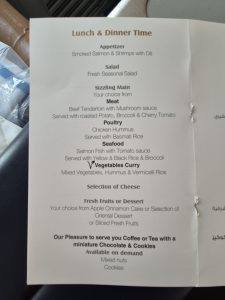
Having spectacularly failed to learn from my experience en-route from Johannesburg, or perhaps simply addled from 30 hours of enforced wakefulness, I opted for the beef tenderloin.
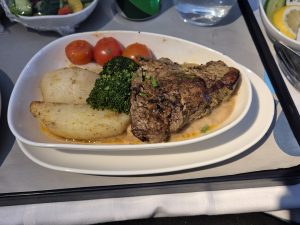
Suffice to say that the result more closely resembled the output of a bovine crematorium than anything remotely comestible.
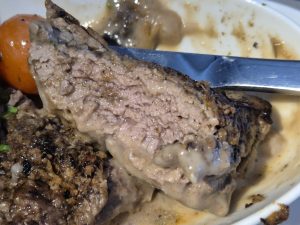
Having decided that the steak was more suitable for fortifying the landing gear than for human consumption, I moved on to the cheese course, which was the pinnacle of the meal.
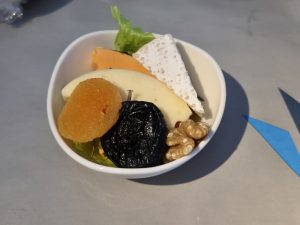
The finale was a delectably senescent fruit platter, which despite the airline’s monastic devotion to sobriety, was probably more intoxicating than anything I had been served in the previous 15 hours.

CONCLUSION
In all honesty, it has been some years since I have been quite so relieved to disembark a flight.
The price I paid for my one-way ticket, £517 ($685) – around a third of the normal fare – is broadly in line with premium economy fares on European carriers. Frankly, the latter would have provided a better experience. I arrived in Madrid every bit as exhausted as I would after an overnight flight in economy class.
In conclusion, this is a product which falls so far short of any expected industry standard, that EgyptAir should be ashamed to describe it as business class.